

Last updated on September 23rd, 2026 at 07:00 am
When heating and cooling performance starts to decline, many homeowners immediately blame the furnace, air conditioner, or thermostat. However, the HVAC equipment may be working perfectly while damaged ductwork quietly wastes conditioned air behind walls, above ceilings, or inside attics.
Duct systems carry heated or cooled air from HVAC equipment to different rooms throughout the home. If ducts develop leaks, loose joints, crushed sections, damaged insulation, or disconnected connections, the system must work harder to maintain comfortable temperatures.
Unfortunately, homeowners rarely see these problems because much of the ductwork remains hidden.
HVAC contractors therefore use a combination of airflow measurements, pressure testing, visual inspection, temperature readings, and system behavior to find problems that are not immediately visible. Accurate diagnosis allows them to repair the actual source of energy loss instead of replacing equipment unnecessarily.
Watching for Changes in Room Comfort
Experienced HVAC contractors often begin with one of the simplest diagnostic tools available: observing how the home feels.
Uneven temperatures frequently provide the first clue that something is wrong with the duct system.
For example, one bedroom may remain much warmer than the rest of the house during summer. Another room may receive very little airflow even though nearby rooms feel comfortable.
These differences can indicate that a duct serving one area has become compressed, disconnected, or damaged.
Contractors may also ask homeowners whether the problem developed suddenly or gradually.
A sudden change could indicate a disconnected section or recent physical damage. Meanwhile, gradual decline may point toward aging connections, deteriorating insulation, or accumulated leakage.
Companies such as Essential Heating and Air represent the type of HVAC professionals homeowners may contact when comfort problems continue despite apparently normal equipment operation.
Instead of assuming the thermostat is responsible, contractors evaluate how conditioned air travels throughout the entire home.
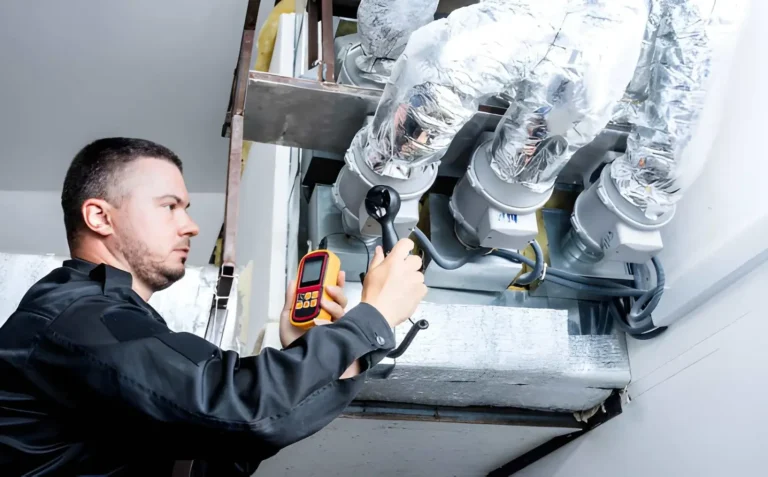
Measuring Airflow at Supply Registers
After discussing comfort problems, technicians may measure airflow at different vents.
The amount of air leaving each supply register helps reveal whether the duct system distributes conditioned air correctly.
If one vent delivers significantly less airflow than comparable vents, the contractor may investigate the branch line serving that room.
Possible causes include:
- Crushed flexible ducts
- Loose duct connections
- Sharp bends
- Internal restrictions
- Closed dampers
- Disconnected duct sections
- Damaged supply boots
Airflow measurements allow contractors to identify patterns rather than rely solely on subjective comfort complaints.
For instance, several vents on one side of the home may show weaker airflow than expected. That pattern could indicate a larger problem near a main trunk or distribution point.
By comparing readings across the property, contractors can narrow down the location of hidden damage.
Checking Static Pressure
Static pressure testing provides another important diagnostic method.
In simple terms, static pressure measures resistance inside the HVAC airflow system.
When pressure becomes too high, the blower must work harder to move air.
Several conditions can create excessive resistance, including dirty filters, restrictive coils, undersized ducts, crushed flexible ductwork, or closed dampers.
On the other hand, unexpected pressure changes can also suggest leakage.
Contractors take measurements at strategic locations in the system to understand how airflow moves through supply and return ducts.
These readings help separate duct problems from equipment issues.
Without testing, a technician might assume that a weak blower caused poor airflow. However, pressure measurements may reveal that the blower works properly while damaged ducts restrict or lose air.
That distinction prevents unnecessary equipment replacement.
Performing Duct Leakage Testing
Small leaks may not look serious individually, but dozens of minor openings throughout a duct system can create significant energy loss.
Therefore, contractors sometimes perform dedicated duct leakage tests.
During testing, technicians pressurize the duct system and measure how much air escapes.
A properly sealed system should retain most of the supplied pressure.
If air escapes quickly, technicians know that leakage exists somewhere in the duct network.
They can then inspect common problem areas such as:
- Duct joints
- Elbows
- Transition pieces
- Plenum connections
- Supply boots
- Return boxes
- Flexible duct connections
This process is much more reliable than simply looking for visible gaps.
Leaks hidden behind insulation or inside enclosed spaces may still show up clearly through pressure testing.
Homeowners searching for professional HVAC diagnosis may also look for services through searches such as hvac near me when persistent airflow or comfort issues require a closer inspection.
Inspecting Flexible Ductwork for Damage
Flexible ducts are common in many homes because installers can route them around framing and other obstacles.
However, improper installation or later disturbance can reduce their performance.
Contractors inspect flexible duct runs for sagging, compression, sharp turns, torn outer jackets, and unsupported sections.
A duct that bends too sharply can significantly restrict airflow.
Similarly, a long flexible duct that sags between support straps may increase resistance and reduce the amount of air reaching the room.
Sometimes the outer insulation looks perfectly normal even though the inner liner has torn or collapsed.
Therefore, HVAC technicians may carefully feel, inspect, or access sections of flexible duct where airflow testing suggests a problem.
Correcting the shape and support of the duct can sometimes restore performance without replacing major HVAC equipment.
Looking for Loose or Separated Duct Joints
Duct systems contain many connection points.
Over time, vibration, temperature changes, poor installation, or physical disturbance can loosen those connections.
When two sections separate, conditioned air may escape into an attic, crawl space, wall cavity, or basement ceiling.
That wasted air never reaches the rooms it was intended to heat or cool.
Meanwhile, the HVAC equipment continues running because the thermostat still detects uncomfortable temperatures.
Contractors inspect accessible seams and connections for gaps, deteriorated sealing materials, or signs of air movement.
Dust streaks around joints can sometimes reveal long-term leakage.
In other areas, technicians may hear air escaping while the system operates.
Even relatively small gaps can contribute to measurable energy loss when the system runs for many hours each day.
Examining Attics and Crawl Spaces
The environment surrounding ductwork often provides important evidence.
In attics, HVAC contractors look for damaged insulation, crushed ducts, pest activity, disconnected sections, and areas where someone may have stepped on or moved the ductwork.
Extreme attic temperatures can also weaken certain materials over time.
In crawl spaces, moisture becomes another concern.
High humidity, standing water, or condensation can damage insulation and metal components.
Support straps may also loosen, allowing ducts to sag or separate.
Contractors inspect these environments carefully because the damage may result from outside forces rather than normal HVAC operation.
For example, contractors working on electrical wiring or insulation may unintentionally shift a flexible duct.
Likewise, rodents can tear duct liners while nesting.
Identifying the cause helps prevent the same damage from returning after repairs.
Checking Supply Boots and Return Connections
Some airflow losses occur where ducts connect to the rooms rather than farther inside the system.
Supply boots connect ductwork to registers, while return boxes collect air and send it back toward the HVAC equipment.
If these areas contain gaps, the system may leak conditioned air or draw unwanted air from surrounding spaces.
Return-side leaks can become particularly problematic.
Instead of pulling air from inside the living space, damaged return ducts may draw dusty, humid, or extremely hot air from attics or crawl spaces.
That additional load forces HVAC equipment to work harder.
Contractors therefore inspect connections around registers, grilles, return boxes, and ceiling penetrations.
Proper sealing at these points can improve both comfort and system efficiency.
Using Temperature Differences to Find Problems
Temperature measurements can also reveal hidden duct damage.
Contractors may compare the air temperature leaving the HVAC equipment with the temperature at distant supply vents.
Some temperature change is normal, especially across long duct runs.
However, unusual differences may indicate leaking air, damaged insulation, or ducts exposed to extreme attic or crawl-space temperatures.
For example, cooled air traveling through poorly insulated attic ductwork may absorb heat before reaching the room.
Likewise, heated air moving through damaged insulation during winter may lose substantial warmth.
Thermal imaging tools can sometimes help technicians identify abnormal temperature patterns without opening walls or ceilings.
These tools do not always reveal the exact defect, but they can guide further investigation.
Identifying Damaged Duct Insulation
Duct insulation reduces unwanted heat transfer and helps control condensation.
When insulation becomes torn, wet, compressed, or missing, system efficiency may decline even when the duct itself does not leak.
This problem commonly appears in attics, crawl spaces, garages, or other unconditioned areas.
Contractors inspect insulation for visible damage and moisture staining.
Condensation may provide another warning sign.
If cold supply ducts run through humid spaces without adequate insulation, moisture can form on their surfaces.
Over time, that moisture can damage insulation and surrounding building materials.
Repairing insulation protects both HVAC performance and the property around the ducts.
Investigating Whistling and Other Unusual Sounds
Air escaping through small openings can create noticeable sounds.
Homeowners sometimes report whistling, hissing, rattling, or popping noises while the HVAC system runs.
Contractors use these sounds as diagnostic clues.
Whistling may indicate air being forced through a narrow opening or restricted section.
Rattling could point to loose metal ductwork.
Popping sounds may occur when sheet metal expands and contracts under changing pressure.
Although noise alone cannot confirm the exact problem, combining sound patterns with airflow and pressure measurements helps technicians narrow down possible causes.
Considering Renovations and Recent Work
Hidden duct problems sometimes begin after unrelated home improvement projects.
Contractors may therefore ask whether homeowners recently completed attic insulation, electrical work, plumbing changes, remodeling, or pest control.
Workers moving through tight spaces can accidentally crush, disconnect, or puncture ducts.
Likewise, homeowners may unknowingly block return vents during renovations.
Knowing when comfort problems started can help connect them to recent activity.
This information can significantly shorten the diagnostic process.
Evaluating Energy Bills
Unexpected increases in electricity or gas bills can also point toward duct inefficiency.
A leaking system may force HVAC equipment to operate longer to maintain the same indoor temperature.
The homeowner therefore pays for conditioned air that never reaches the living space.
Energy pricing also influences how noticeable that waste becomes.
In areas where household costs depend on changing Texas electricity markets, reducing unnecessary HVAC energy consumption can become especially important.
Homeowners should compare utility bills from similar weather periods rather than focusing on one unusually hot or cold month.
A persistent increase combined with longer HVAC run times and uneven temperatures often deserves professional investigation.
Why Proper Diagnosis Matters
Poor airflow does not automatically mean that the air conditioner or furnace needs replacement.
Replacing expensive equipment without inspecting the duct system may leave the homeowner with exactly the same comfort problem.
Accurate diagnosis allows contractors to determine whether the issue comes from the blower, coil, filter, ductwork, thermostat, or another component.
Once technicians identify the actual source, they can recommend targeted repairs.
Those repairs may involve sealing leaks, reconnecting joints, replacing damaged flexible ductwork, improving support, restoring insulation, or correcting airflow balance.
This approach often costs less than replacing perfectly functional HVAC equipment.
Conclusion
Hidden duct damage can reduce HVAC efficiency for months or even years before homeowners realize what is happening.
Leaks, crushed sections, damaged insulation, loose joints, sagging flexible ducts, and poorly sealed return connections can all reduce airflow while forcing heating and cooling equipment to run longer.
Professional HVAC contractors identify these problems by combining several diagnostic methods.
They study comfort patterns, measure airflow, check static pressure, perform leakage tests, inspect accessible ductwork, evaluate insulation, listen for unusual sounds, and examine attics or crawl spaces for environmental damage.
Most importantly, they look beyond the HVAC equipment itself.
When contractors identify the actual pathway where conditioned air is being lost or restricted, repairs become more accurate and effective.
Restoring duct integrity can improve room-to-room comfort, reduce unnecessary energy consumption, decrease equipment strain, and help the entire HVAC system operate closer to its intended performance.
Also Read


1 thought on “How Do HVAC Contractors Identify Hidden Duct Damage That Reduces Efficiency?”