


Every successful business ultimately comes right back to one central issue: cost management. Regardless of the boldness of the design or the skill of the crew, a mission without strict monetary controls contributes to financial overruns, schedule slippage, and diminishing profitability. Cost control is not a one-time task completed at the beginning of a business — it is a continuous, end-to-end system that includes initial estimates, bid exercises, procurement, trade controls, and conclusions. In conducting the estimate, cost control was integrated around the cost gap and sustainable growth. As competition increases and customers demand additional transparency and accountability, it has become a critical objective. This article explores the add-ons of the complete payment management process, the specific offerings that help it, and the measurable business impact of getting payment management right.
2. Establishing cost control from the bottom
Effective cost control begins long before production teams arrive on the website — it begins with a disciplined, thorough estimation method that establishes a concrete financial basis for the entire challenge. Without this foundation, every subsequent budget decision is built on shaky ground. Many companies tighten this critical first step by partnering with electrical-estimating services that understand local test markets, textile price development, jurisdiction-specific code requirements, and a thorough early-stage assessment to identify potential cost issues for tasks, expectation settings, and a savvy checkpoint in the challenge timeline. When the baseline numbers are right, each downstream contribution changes the department — from procurement to business management from a baseline that teams can actually trust instead of constantly correcting the initial miscalculations they run.
Deliveries
- Cost shifting starts with a disciplined, thorough initial assessment.
- Understanding regional prerequisites reduces early-stage financial risk.
- An honest foundation improves efficiency at every stage after the payment pipeline.
- Realistic early numbers help manage customer expectations from day one.
3. Measuring the Business Impact of Integrated Cost Control
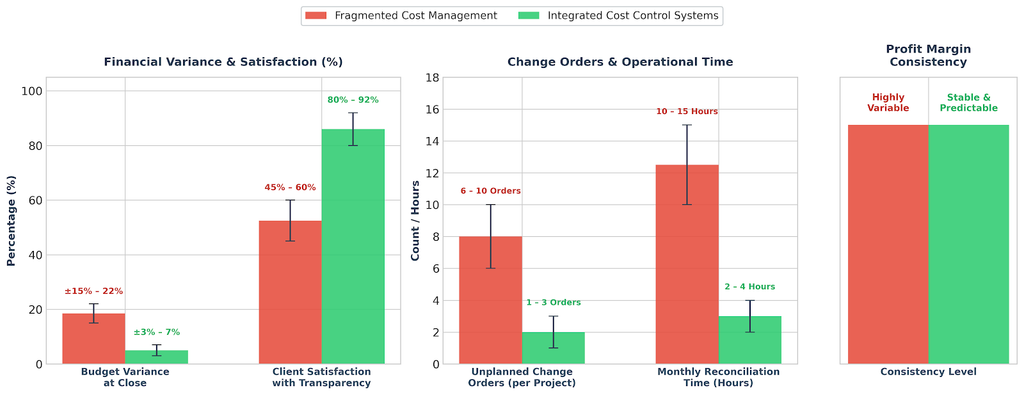
Firms that implement prioritized, stop-to-give-up cost manipulation strategies consistently outperform fragmented, departmental accounting with the help of department control. The table below highlights the differences between the typical performance of disaggregated cost control and absolutely contained cost manipulation systems.
| Performance Metric | Fragmented Cost Management | Integrated Cost Control Systems |
| Average Budget Variance at Project Close | ±15% – 22% | ±3% – 7% |
| Frequency of Unplanned Change Orders | High (6 – 10 per project) | Low (1 – 3 per project) |
| Profit Margin Consistency Across Projects | Highly variable | Stable and predictable |
| Time Spent Reconciling Budgets Monthly | 10 – 15 hours | 2 – 4 hours |
| Client Satisfaction with Cost Transparency | 45% – 60% | 80% – 92% |
Budget Variance Reduction Over Time (Illustrative, 8 Reporting Periods)
The steady decrease in budget variance depicted above is the standard for companies that adopt integrated cost control practices over the years. As accuracy estimates improve, alternative order documentation becomes more disciplined, and monetary reporting tightens, the gap between projected and actual interruption costs narrows significantly. This consistency does more than protect individual operating margins — it strengthens a company’s general monetary plan
4. Strengthening the bidding process through cost accuracy
Cost shifting begins even before the company is presented, all through an aggressive bidding block, where price accuracy can determine whether the company wins drawings on a particular topic. Highly competitive offers threaten unprofitable contracts, even as ultra-conservative offers threaten to abandon prospects altogether. That’s why many companies rely on accurate construction bid evaluation services to strike the right balance between bidding competitively on pricing and maintaining the desired margin of healthy challenge allocation. These unique bids combine modern market information with unique space flights, ensuring that each bid submitted reflects a realistic challenge fee instead of a hard close. A specific, well-supported bid is the most effective not only to improve winning prices but also to set the stage for strong price control at some stage of the challenge, as the original bid will be the benchmark against which the overall performance of all future budgets will be measured. Firms that get this score higher avoid the usual lure of starting business early on the back of the margin.
Deliveries
- Bid accuracy immediately impacts every profit margin and ultimately the company’s profitability.
- Broad flights protect you from any overly aggressive and overly conservative pricing.
- Accurate bidding meets the criteria for all-time budget control.
- Strong bidding practices set the tone for the customs sector for the time being.
5. Comparison of Price Control Distribution Models
Organizations typically choose between managing costs and manipulating them entirely in-house, outsourcing key functions to specialized partners, or a mix of 2 approaches. Each model offers unique benefits based on company length, size of challenge, and insider information.
| Factor | Fully In-House Cost Control | Outsourced / Specialist-Supported Cost Control |
| Initial Investment | High (staffing, software, training) | Moderate (project-based or retainer fees) |
| Scalability During High-Volume Periods | Constrained by staff capacity | Flexible and easily scaled |
| Access to Specialized Estimating Tools | Often limited or outdated | Typically current and industry-specific |
| Consistency of Reporting Standards | Dependent on individual staff | Standardized across all projects |
| Speed of Implementation for New Projects | Slower onboarding | Faster, process-driven onboarding |
Many developing companies adopt a shared model where they outsource specialized tasks while retaining the core financial controls in-house that include specific estimates, bid guides, or technical documentation. This approach maintains strategic leadership over cost decisions as they gain access tospecialists’s knowledge and mathematical skills when needed most.
Deliveries
- Unclear technical documentation is a common hidden driver for exceeding fees.
- Accurate, up-to-date drawings reduce changes and discipline-grade price surprises.
- Clear documentation supports accurate ongoing cost forecasting.
- Without delay, strong proposals support the economic sector.
6. Technical Accuracy as a Cost Control Factor
Cost overruns often do not stem from poor budgeting, but from inaccurate or incomplete technical documentation, which results in misinterpretations, redesigns, and expensive material adjustments.s Accurate drawings are thus a critical, usually underestimated part of efficient project management. Firms that incorporate expert CAD drafting services into their workflow ensure that every part, from estimators to discipline teams, is working from clear, accurate, and up-to-date technical documentation. This reduces the chance of costly misunderstandings, reduces changes, and helps achieve more accurate pre-clearance. When drawings are unique and continuously updated, price management groups can do more with a bit of luck price range performance to real scope, due to the fact that ambiguity is eliminated as supply of variance Thus, firm proposal support capabilities.
7. Final Thoughts
Perfect price manipulation is not achieved by a single tool or company; it is the result of disciplined practices implemented consistently from initial valuations to final closure by companies that spend money on accurate early-stage valuations, especially competitive bidding and estate reporting. Clean technical documentation also helps deliver projects on budget, generating the kind of popularity that attracts repeat business and referrals as the construction industry faces rising material fees, labor costs, and increasingly sophisticated clients from groups that address broad-based projects, quiet zones, and quiet markets. Improving consumer acceptance as truth and achieving sustainable long-term growth.
Frequently Asked Questions
Question 1: Why is estimating the initial level considered the foundation of price control? A: Each subsequent budgeting and forecasting option is based on the accuracy of the original estimate, making it the reference factor against which all future cash flow performance is measured.
Question 2: How does bid price accuracy affect long-run operating profitability?
A: An appropriately priced quote maintains the desired margin for healthy delivery, while an unpaid quote can lock the challenge into unprofitable terms before work even begins
.
Q3: What is the biggest advantage of an inclusive payment management tool over a fragmented one?
A: The integrated system provides consistent visibility into all challenge stages, significantly reducing financial variances and increasing the predictability of revenue margins.
Q4: Should small businesses outsource value-added functions, non-value-added functions, or build internal teams?
A: It depends on the business volume and whether the business is being acquired; Many SMEs benefit from flexible scaling while outsourcing specialized skills to manage pricing.
Q5: How does the availability of documents have a satisfactory impact on the normal payment process?
A: Clear, detailed drawings reduce ambiguity and rework, a common source of cost range, making documentation an immediate thing in first-class cost management.
Also Read
- How Do HVAC Contractors Identify Hidden Duct Damage That Reduces Efficiency?
- 154+ Plant Pick Up Lines That Will Help Your Love Life Bloom For 2026!
- ASL Meaning in Text: What Does ASL Mean in 2026? Complete Slang Guide

