

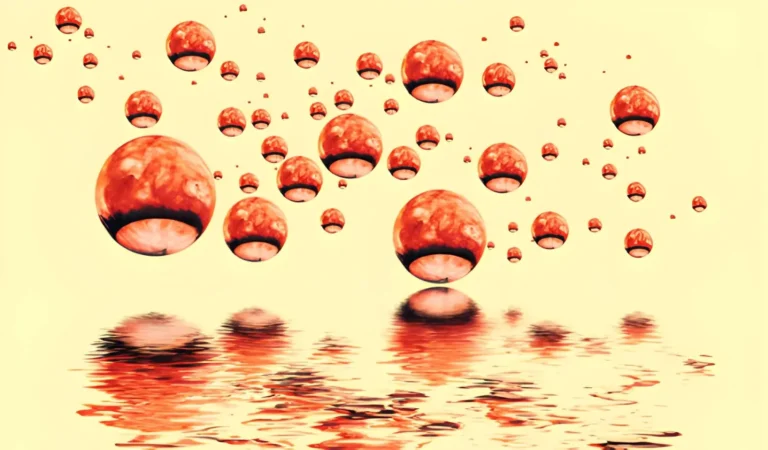
Floating soap spheres may look simple, but they reveal fascinating principles of physics and chemistry. bubbles can appear in soapy water, carbonated drinks, oceans, boiling liquids, and many other environments. Their formation involves gases, liquids, pressure, surface tension, and sometimes extremely thin films that produce striking colors.
These structures are not all the same. Some contain ordinary air, others contain carbon dioxide or water vapor, while large collections can form foam. Understanding these differences helps explain why they form, rise, change shape, display rainbow colors, and eventually disappear.
What Are These Gas-Filled Structures?
In simple terms, a bubble is a pocket of gas surrounded by liquid. Its exact structure depends on where and how it forms.
A soap version consists of gas enclosed by a thin liquid film stabilized by soap molecules. Carbonated beverages contain pockets of carbon dioxide within liquid, while boiling water develops vapor-filled regions.
Temperature, pressure, liquid composition, and surrounding conditions all affect how these structures behave.
Major Types Found in Everyday Life
Several forms occur naturally or through everyday activities.
Soap-Film Spheres
These form when air becomes enclosed by a thin layer of soapy water. Soap stabilizes the film and allows it to stretch without breaking immediately.
Air Pockets in Water
Splashing, pouring, waves, and waterfalls can trap air beneath water. Because gas is less dense than the surrounding liquid, these pockets generally rise toward the surface.
Carbonation
Soft drinks and sparkling water contain dissolved carbon dioxide under pressure. Once the container is opened, some gas escapes from the liquid and forms visible pockets.
Vapor Pockets
During boiling, vapor forms within the liquid. These regions grow and rise before releasing vapor at the surface.
Foam
Foam consists of many gas pockets separated by thin liquid films. Soap lather, sea foam, whipped foods, and some beverages provide familiar examples.
How Does a Soap Film Form?
Water molecules attract one another, producing surface tension.
Plain water generally cannot maintain a flexible floating film for long. Soap changes its surface properties by reducing surface tension and stabilizing the thin layer.
When air enters this flexible film, the surface stretches around it. If the film remains stable, a closed floating sphere forms.
Water quality, soap concentration, humidity, temperature, and contamination can all affect durability.
Why Is the Shape Round?
Surface tension tends to minimize surface area.
For a given enclosed volume, a sphere has the smallest possible surface area. A freely floating flexible film therefore naturally tends toward a rounded shape.
It can temporarily become distorted by wind, contact with objects, or interaction with another film. Once those forces are removed, surface tension continues pulling it toward a sphere.
This also explains why a square or triangular wand does not normally create a permanently square or triangular floating form.
Why Do Rainbow Colors Appear?
The colorful surface of bubbles is primarily produced by thin-film interference.
Light reflecting from the outer and inner surfaces of a soap film interacts. Depending on the film’s thickness and the wavelength of light, some colors become more visible while others are reduced.
The film continuously changes thickness as liquid drains downward and water evaporates. As a result, blue, green, yellow, pink, purple, and other colors may appear to move across the surface.
What Makes a Soap Film Pop?
A soap film is extremely delicate, and several factors can cause it to rupture.
Evaporation: Water gradually leaves the film, making it thinner and weaker.
Dry air: Low humidity can accelerate evaporation.
Contact: A dry finger, fabric, wall, or another object can disrupt the film.
Dust and oil: Contaminants may create weak points in the surface.
Strong airflow: Wind can stretch and deform the film until it breaks.
How Long Can One Last?
There is no fixed lifetime.
Some soap films break almost immediately, while others can survive considerably longer under favorable conditions. Their lifespan depends on humidity, evaporation, airflow, temperature, solution composition, film thickness, and contact with surrounding surfaces.
Higher humidity can sometimes help because it may slow water evaporation. Dry and windy conditions generally make maintaining a delicate film more difficult.
What Happens in Carbonated Drinks?
Carbonation works differently from a soap film.
Carbon dioxide is dissolved in the beverage under pressure. Opening the container lowers the pressure above the liquid, allowing some dissolved gas to escape.
Microscopic scratches, imperfections, or particles can act as nucleation sites where gas begins collecting. The gas pockets grow, detach, and rise, producing the familiar fizz seen in sparkling beverages.
What Happens During Boiling?
Heating water increases its vapor pressure. Under boiling conditions, vapor-filled regions can develop within the liquid instead of evaporation occurring only at the surface.
These regions grow and rise through the water before releasing vapor.
The process demonstrates how similar-looking structures can form through completely different physical mechanisms.
Where Do They Occur in Nature?
Gas-filled pockets occur in oceans, rivers, streams, waterfalls, wetlands, and geothermal environments.
Waves and turbulent water can trap air, while natural organic substances may help stabilize foam. Gases can also enter or develop within liquids through biological, geological, or physical processes.
This makes the phenomenon common far beyond household soap solutions.
Single Gas Pockets vs. Foam
An isolated gas pocket has its own surrounding boundary. Foam consists of many closely packed pockets separated by thin liquid films.
When numerous pockets gather together, they can deform and develop flatter boundaries where they touch.
This gives foam physical properties that differ from those of an isolated floating sphere.
Why Scientists Study Soap Films
Soap films offer a simple way to observe important scientific concepts, including:
- Surface tension
- Geometry
- Pressure
- Fluid behavior
- Evaporation
- Molecular interactions
- Optics
- Thin-film interference
Because many effects are visible without advanced equipment, soap films are especially useful for classroom demonstrations and introductory experiments.
Everyday Applications
Gas-filled structures and foams have many practical applications.
In cleaning products, foam can influence how a solution spreads and behaves, although more foam does not automatically mean better cleaning.
In foods and beverages, trapped gases can affect texture, volume, appearance, and mouthfeel. Familiar examples include whipped cream, bread, sparkling drinks, and foamed desserts.
Soap films are also useful in scientific demonstrations and creative photography. Controlled foams and gas-liquid systems additionally have specialized applications in manufacturing and research.
Simple Experiments to Try
A few easy experiments can demonstrate the science.
Try different soap-to-water ratios and compare how long the resulting films survive. Change only one factor at a time for a fairer comparison.
You can also experiment with circular, square, and triangular wands. The film may initially follow the shape of its frame, but a freely floating form tends toward a sphere.
Another experiment is to observe a film under good lighting and watch its colors change as its thickness changes.
Final Thoughts
From colorful soap films to sparkling drinks, ocean foam, and boiling water, bubbles provide an accessible demonstration of important scientific principles. Surface tension, pressure, evaporation, buoyancy, gases, and light can all influence their formation and behavior.
These seemingly simple structures show how complex physical and chemical processes can be observed in ordinary life, making them valuable for education, experimentation, photography, and scientific study.
Also Read
- https://flirtsnacks.com/why-does-a-washing-machine-smell-musty-even-when-its-used-every-week/
https://flirtsnacks.com/some-groups-in-your-data-can-answer-the-question-and-some-cannot/
https://flirtsnacks.com/why-e-liquid-storage-conditions-matter-light-heat-and-shelf-life/

