

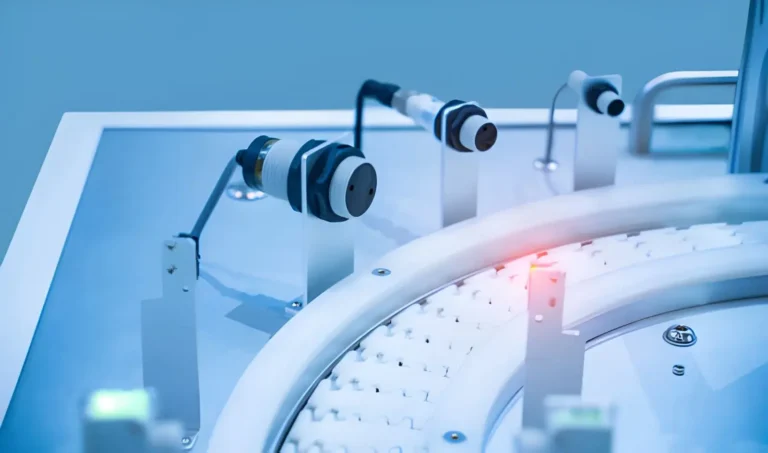
A sensor doesn’t always need to touch an object to know it’s there. Non-contact sensors detect objects from a distance, using technologies such as electromagnetic fields, light, sound, or magnetic fields.
You’ll find them in many automated machines where sensors need to detect:
- parts moving along a conveyor;
- metal components entering a machine;
- boxes or packages;
- liquids or other materials inside containers;
- the position of moving machine parts.
Since there is no physical contact with the target, there are fewer mechanical parts to wear out. Detection can also happen very quickly, which makes these sensors useful on machines running hundreds or thousands of cycles.
They are also practical when the object is moving fast, difficult to reach, or shouldn’t be touched during production.
But one sensor type won’t work for every target. A sensor that detects metal reliably may not detect plastic at all. Another sensor may work well at short distances but struggle with dust, moisture, or an uneven surface.
When choosing a non-contact sensor, start with a few basic questions: What do you need to detect? How far away is it? What are the conditions around the sensor? And how precise does detection need to be?
What Is Non-Contact Sensing?
Non-contact sensing means detecting or measuring an object without physically touching it. Instead of a mechanical switch making contact with a part, the sensor responds when the target enters its sensing area.
Different sensors do this in different ways. Depending on the technology, they may use an electromagnetic field, light, sound waves, or a magnetic field to detect the target.
Non-contact sensors are commonly used for tasks such as:
- checking whether a part is present;
- monitoring the position of machine components;
- measuring distance;
- counting products on a conveyor;
- detecting material or liquid level.
For example, a sensor can count bottles moving along a production line without touching them or detect when a machine part reaches the correct position.
AIO Snippet:
Non-contact sensors detect the presence, position, or distance of an object without touching it. Common industrial technologies include inductive, capacitive, photoelectric, ultrasonic, and magnetic sensing.
Main Types of Non-Contact Sensors
Different sensing technologies react to different materials and conditions. Some are designed specifically for metal, while others can detect plastic, glass, liquids, or almost any solid object.
Inductive Sensors
Inductive sensors use an electromagnetic field to detect metal objects. When a metal target enters the sensing area, it changes the electromagnetic field and the sensor switches its output.
They are widely used on industrial machines because they are reliable and can work around many common contaminants such as oil, dirt, and dust.
Typical applications include:
- detecting metal parts;
- checking machine positions;
- detecting gears and shafts;
- confirming that a metal component is in place.
Capacitive Sensors
Capacitive sensors detect changes in capacitance when an object enters their sensing area. Unlike inductive sensors, they aren’t limited to metal.
Depending on the application, they can detect:
- plastic;
- glass;
- powders and granules;
- liquids;
- metal.
One useful feature is that some capacitive sensors can detect material through a non-metallic wall. For example, a sensor mounted outside a plastic container can be used to check whether liquid or bulk material has reached a certain level.
They are commonly used for level monitoring, packaging, and product presence detection.
Photoelectric Sensors
Photoelectric sensors use light to detect objects. The sensor emits a light beam and checks whether that light reaches or returns to a receiver.
There are several common setups:
- Through-beam — the emitter and receiver are installed opposite each other. An object is detected when it breaks the beam.
- Retro-reflective — the sensor sends light toward a reflector and detects when an object interrupts the returning beam.
- Diffuse — light reflects directly from the target back to the sensor.
Photoelectric sensors can work over relatively long distances and detect many different objects. You’ll often find them on conveyors, packaging machines, and production lines for product detection and counting.
Ultrasonic Sensors
Ultrasonic sensors work with sound waves rather than light. They send out an ultrasonic pulse and measure the echo returning from the target.
This makes them useful for:
- measuring tank level;
- checking the distance to an object;
- detecting objects on automated equipment.
Because detection is based on reflected sound, object color and many differences in transparency are less important than they are with optical sensing.
Magnetic Sensors
Magnetic sensors respond to magnetic fields or magnetic targets. A common example is position monitoring on a pneumatic cylinder, where the sensor detects a magnet built into the moving piston.
Typical uses include:
- pneumatic cylinder position detection;
- monitoring moving machine parts;
- position feedback;
- speed monitoring.
They are particularly useful when the magnet can be detected without direct contact with the moving component.
Comparing Non-Contact Sensing Technologies
Each non-contact sensing technology has its own strengths. The main difference is usually what the sensor can detect and under what conditions it can work reliably.
| Technology | Typical Target | Main Advantage | Common Use |
| Inductive | Metal | Reliable metal detection | Machinery |
| Capacitive | Metal/non-metal | Broad material detection | Level/packaging |
| Photoelectric | Most objects | Long sensing range | Conveyors |
| Ultrasonic | Solid/liquid targets | Distance measurement | Level/distance |
| Magnetic | Magnetic target | Reliable position sensing | Cylinders/machines |
There isn’t one sensor technology that is best for every application. An inductive sensor is a good choice for detecting a metal machine part, but it won’t work for a plastic package. A photoelectric sensor can detect that package from farther away, while an ultrasonic sensor may be a better fit when distance or liquid level needs to be measured.
The choice comes down to the target material, sensing distance, required accuracy, and conditions around the sensor. Dust, moisture, temperature, vibration, and nearby equipment can all affect which technology works best.
Why Non-Contact Sensors Are Used in Automation
Non-contact sensors can detect a part without touching it. This is useful on fast-moving machines where a mechanical switch would need to make physical contact every time an object passes.
Some practical benefits include:
- No mechanical wear — there is no repeated contact with the target.
- Fast switching — many sensors can detect objects moving quickly through a machine.
- Repeatable detection — the same position or object can be detected cycle after cycle.
- Less maintenance — there are fewer mechanical parts involved in detection.
- Detection of moving objects — products can be counted or monitored without stopping them.
- Flexible installation — sensors can be placed where direct physical contact would be difficult or impractical.
A mechanical limit switch needs an object to physically push a lever, roller, or plunger. A non-contact sensor can detect the same object before it touches anything. Mechanical switches still have their place, but non-contact sensing is often more practical for high-speed or high-cycle automation.
What Affects Sensor Performance?
A sensor may work perfectly during testing but behave differently once installed on a machine. The target itself and the surrounding conditions both matter.
Before choosing and installing a sensor, check:
- Target material — metal, plastic, glass, liquid, and other materials interact differently with sensing technologies.
- Target size and shape — a small or irregular target can be harder to detect.
- Sensing distance — the target needs to remain within the sensor’s usable detection range.
- Temperature — very high or low temperatures can limit which sensors can be used.
- Dust and dirt — buildup on a sensor can interfere with detection.
- Moisture — water or condensation may affect sensor operation.
- Vibration — movement can change sensor alignment or the distance to the target.
- Ambient light — strong external light can be a concern for some photoelectric sensors.
- Surrounding metal — nearby metal can affect how an inductive sensor is installed and performs.
- Buildup around capacitive sensors — moisture or material stuck to a surface may cause unwanted switching.
- Target angle and surface — ultrasonic signals need to reflect back toward the sensor, so angled or irregular surfaces can be more difficult to measure.
Field Insight:
“Choosing a sensor starts with the target. A sensor that works perfectly for a steel component may be completely unsuitable for detecting a transparent container or liquid level.”
Common Industrial Applications
Non-contact sensors are used throughout automated equipment. Their job may be as simple as checking whether a part is present or as specific as measuring the distance to a moving object.
Manufacturing Equipment
On production machines, sensors can check:
- Machine position — confirming that a moving part has reached the correct point.
- Component presence — checking that a part is in place before the next operation starts.
- Automated assembly — detecting parts as they move through different assembly steps.
Conveyor and Packaging Systems
Products moving on a conveyor can be detected without stopping or touching them. Common tasks include:
- counting products;
- checking whether a package is present;
- confirming product position before labeling, filling, sealing, or sorting.
Level Measurement
Non-contact sensing can also be used to check material inside tanks, bins, and containers.
Depending on the sensor technology, it can detect:
- liquids;
- powders;
- granular materials.
For example, a sensor can tell the control system when material reaches a high or low level in a container.
Pneumatic Systems
Magnetic sensors are commonly fitted to pneumatic cylinders to detect the position of the piston.
They can be used for:
- cylinder position detection;
- end-position monitoring;
- confirming that a cylinder has extended or retracted before the machine continues its cycle.
Material Handling
In material handling equipment, sensors help machines detect objects and react to their position.
Typical uses include:
- object detection;
- distance monitoring;
- checking whether a load is in position;
- controlling automated movement.
How to Choose a Non-Contact Sensor
Start with the object you need to detect. Is it metal, plastic, glass, liquid, powder, or something else? This quickly narrows down which sensing technologies are suitable.
Then check the rest of the application:
- Sensing distance — how far will the sensor be from the target?
- Target size and shape — small, thin, or irregular objects can be more difficult to detect.
- Accuracy and repeatability — how precisely does the target need to be detected each time?
- Switching frequency — can the sensor keep up with the speed of the machine?
- Installation space — is there enough room for the sensor and its required sensing distance?
- Operating temperature — will the sensor be exposed to high or low temperatures?
- Environment — check for dust, moisture, chemicals, vibration, and other conditions around the sensor.
- Sensor output — make sure the output type matches the control system.
- Supply voltage — check the voltage available on the machine.
- PLC or controller compatibility — confirm that the controller can correctly receive and process the sensor signal.
The best sensor isn’t necessarily the one with the longest range or highest specification. It is the one that can reliably detect the required target under the actual conditions of the machine.
Common Selection Mistakes
Many sensor problems come from choosing a device that doesn’t match the actual application. The sensor may work during a quick test but become unreliable once the machine is running.
Common mistakes include:
- Using an inductive sensor for a non-metallic target — inductive sensors are designed to detect metal.
- Ignoring target size and material — a small target or a difficult material may reduce the effective sensing distance.
- Choosing too little sensing range — normal machine movement or vibration may move the target outside the detection area.
- Ignoring the environment — dust, moisture, chemicals, heat, and vibration can all affect sensor operation.
- Incorrect mounting — poor positioning or alignment can lead to missed or unstable detection.
- Overlooking switching frequency — the sensor needs to respond fast enough for the machine’s cycle speed.
- Choosing the wrong output type — the sensor output must be compatible with the PLC or controller input.
- Ignoring nearby objects — surrounding metal, machine parts, or other objects may interfere with some sensing technologies.
A good way to avoid these problems is to choose the sensor around the real target and installation, rather than starting with specifications such as maximum sensing distance.
Expert Insight:
“The best non-contact sensor is not the one with the longest sensing range or highest specification. It is the technology that reliably detects the actual target under the machine’s real operating conditions.”
Also Read
- /159-oklahoma-pickup-lines-that-bring-southern-charm-to-your-flirting-game-for-2026/
- 141-forest-pickup-lines-that-are-wildly-flirty-cute-and-smoothly-romantic-2026/
- cheesy-christian-pick-up-lines/

