

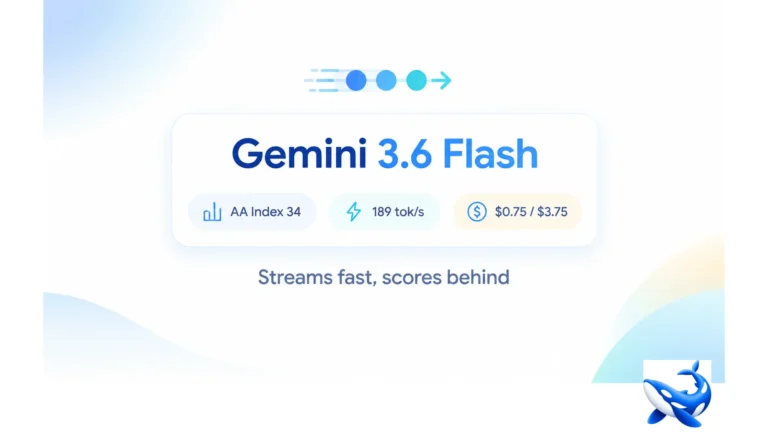
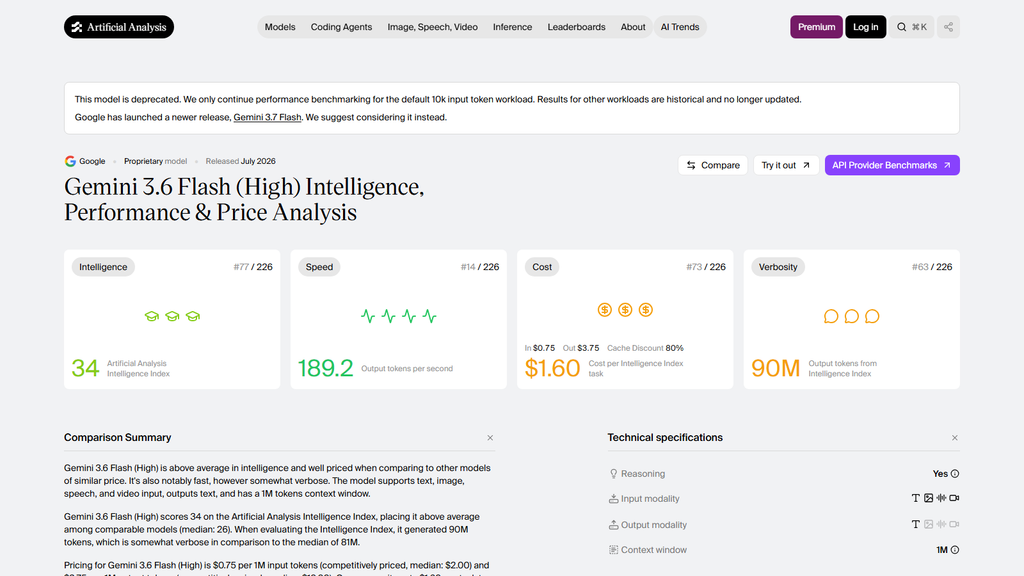
On OrcaRouter we host the Gemini 3.6 Flash model — the middle rung of Google’s current Flash generation, shipped on July 21, 2026, priced at $0.75 per million input tokens and $3.75 per million output, with a 1M-token context window. Artificial Analysis measures its output speed at 189.2 tokens per second — among the fastest of any Flash card we serve — while scoring it 34 at the high reasoning setting, seven points behind its 3.8 sibling. In production its p50 time-to-first-token is 4.10 seconds. It is carried at list price on the same key as every other Google model, with the live telemetry on the linked page.
The interesting thing about a mid-generation Flash card is that its two headline numbers point in opposite directions, and this article is about reading that properly.
The output speed that keeps it alive
At 189.2 tokens per second of measured output, 3.6 Flash is one of the fastest streamers in the current Flash line — materially faster than its own successor, which measures 122.7 tokens per second. Output speed is the number your users feel most: it is the rate at which the answer appears, and for long generations it determines whether a tool feels responsive or sluggish. A card that streams at 189 tokens per second finishes a 2,000-token answer in about eleven seconds, which is a visible product difference for chat, summarization and report workloads.
That speed is why the mid rung still earns production traffic despite its successor: not every workload chases the reasoning score. Teams whose output is long and whose scoring needs are modest — drafting, rewriting, extraction, batch prose — have a real incentive to stay on the faster streamer.
The practical case is easiest to see in batch work. A summarization pipeline that runs a million tokens a night cares about wall-clock completion, and at 189 tokens per second the same job finishes on this card in about an hour and a half of stream time that a slower model would stretch across the shift. Throughput like that does not appear in a reasoning index, which is exactly why the two headline numbers of this card point in different directions — each one is correct for the workload it describes.
The generation, side by side
| model | release | context | input / output | AA index (config) | output speed | p50 TTFT |
| Gemini 3.8 Flash | 2026-09-02 | 1M | $0.75 / $3.75 | 41 (high) | 122.7 tok/s | 3.87 s |
| Gemini 3.6 Flash | 2026-07-21 | 1M | $0.75 / $3.75 | 34 (high) | 189.2 tok/s | 4.10 s |
| Gemini 3.5 Flash | 2026-05-23 | 1M | $1.50 / $9.00 | 33 (high) | 197.4 tok/s | 8.21 s |
Release dates and rate cards are what Google lists; the index, output speed and per-task cost are Artificial Analysis’s live readings; the TTFT column is production telemetry from the linked page. Read the speed column and the index column together and the mid rung’s position becomes clear: it streams at nearly the previous generation’s rate while scoring a point above it, and its successor trades output speed for a seven-point score gain. Google has effectively split the Flash line — the mid rung is the fast one, the new rung is the smart one, and the buyer chooses by workload, not by number.
The per-task column, present in the readings even when it is not the headline, reinforces the split: $1.60 for the mid rung against $1.24 for the successor. The faster card is not cheaper on the standard task set — it reads and writes more tokens to finish the same job, which is the honest trade for streaming speed. What the buyer gives up in task-level economy they get back in wall-clock time, and for long-output workloads the wall clock is the number that pays the bill.
When the 34 is the right number
The honest framing for a 34 (high) score is that it is a single-turn reasoning measurement, and single-turn reasoning is not the only axis on which a Flash card is bought. For the long-output workloads that the mid rung is fastest at, the binding constraint is throughput and price, not the reasoning ceiling — and on throughput and price this card is the best in its generation. The per-task cost of $1.60 on the standard task set is honest about what it does: it is the middle of the Flash line, priced at the same card as its successor.
That is the correct way to read the pairing: Google did not price the mid rung as a discount card. It priced both rungs identically and let the buyer choose between output speed and index score. The mid rung’s traffic — 2.2 million tokens a week on the linked page — is small, which is the market voting for the newer score; but the teams that stay are voting for the streaming speed, and that is a real constituency.
The latency number nobody should ignore
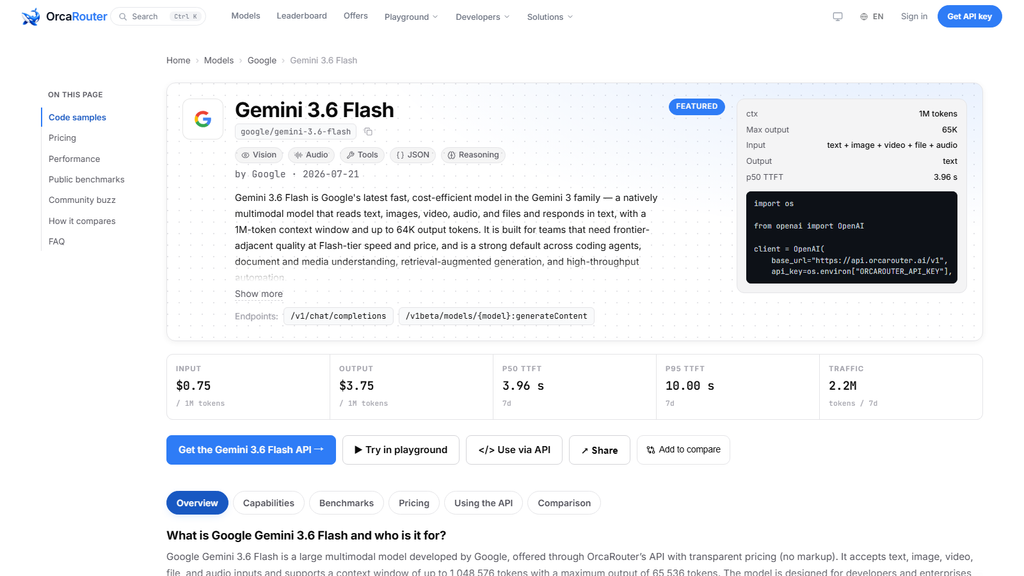
The linked page shows a p50 first token of 4.10 seconds, and that number does more work than the score in deciding where this card fits. First-token latency is what an interactive user waits for before anything appears; at four seconds, the card feels like a deliberate thinker rather than an instant responder. Against its own successor’s 3.87 seconds it is a wash, but measured against the fastest small cards in the industry the whole Flash line carries a first-token tax, and this rung is squarely inside it.
The disciplined reading is that 3.6 Flash is a throughput card, not a latency card and not a reasoning card. It is the right endpoint for workloads that stream long outputs cheaply and do not need top-tier reasoning — and the wrong endpoint for interactive agents and the hardest reasoning tiers. Its production record on the linked page is small but real, and it behaves exactly as the two independent numbers say it should.
One more number on the linked page is worth naming: 2.2 million tokens a week is small, but it is not noise. It is a constituency that keeps a production endpoint alive at the same price as the smarter sibling, and the reason it persists is visible in the two independent numbers this article has been balancing — nobody pays list price for 4.10 seconds of first-token latency and a 34 score out of habit. The teams on this card are on it because long-output throughput is their binding constraint, and that is a defensible, specific choice rather than a default.
The takeaway
Gemini 3.6 Flash is the fast-streaming middle rung of Google’s Flash line: $0.75 / $3.75, a 1M context window, a measured output speed of 189.2 tokens per second, and an independent score of 34 (high) that trails its successor by seven points. Its p50 first token of 4.10 seconds is the Flash line’s honest latency profile, and its 2.2 million weekly tokens show a real but small constituency. Choose it when output throughput is the binding constraint and the reasoning ceiling is not — the successor is the smarter card, and the linked page shows both numbers to make the call.
Sourcing note: release date, context window and rate card are what Google lists and have not been independently reproduced. The Intelligence Index score, output speed and per-task cost are from Artificial Analysis’ live model page, read 2026-10-08, and the 34 was measured at the high reasoning setting. The p50 time-to-first-token and seven-day token volume are OrcaRouter production telemetry from the linked model page. All checked 2026-10-08.
Also Read
- https://flirtsnacks.com/inside-austins-strip-club-scene-where-nightlife-meets-community/
- https://flirtsnacks.com/nurturing-mind-and-body-a-comprehensive-guide-to-fertility-therapy/
- https://flirtsnacks.com/single-station-machines-when-they-make-sense-in-a-home-gym/


1 thought on “Gemini 3.6 Flash: Fast Output, But the Index Is Behind 3.8”