

Cooling towers rarely get attention until something fails. A chiller trips, process temperatures rise, or production slows. By then, problems like scaled fill, clogged nozzles, or poor water treatment have usually been building for weeks.
In Thailand, the risk is higher. Heat and humidity keep cooling loads high year-round, towers get few shutdown windows, and the rainy season adds debris and biological growth.
This industrial cooling tower maintenance checklist gives plant managers and maintenance teams a practical daily-to-annual schedule to catch problems before they cause downtime. Adjust intervals to your manufacturer’s guidance, water treatment program, and operating conditions.
Table of Contents
- Why Cooling Tower Maintenance Is a CEO-Level Decision
- The Cost of Neglect in Manufacturing Facilities
- Maintenance Considerations for Thailand’s Climate
- The Complete Cooling Tower Maintenance Checklist
- Daily Monitoring
- Weekly Checks
- Monthly Inspections
- Quarterly & Annual Maintenance
- Managing Legionella Risk
- Early Warning Signs That Need Attention
- Performance Signs
- Physical Signs
- Preventive vs. Reactive Maintenance
- In-House or Outsourced Maintenance?
- Questions for Managers to Ask Their Team
- Executive Decision Framework: How CEOs Should Manage Cooling Systems
- Key Questions to Ask
- Action Plan
- Securing Your Manufacturing Future
- Frequently Asked Questions
- How often should an industrial cooling tower be maintained?
- What is the most important cooling tower maintenance task?
- How does Thailand’s climate affect cooling tower maintenance?
- What are signs that a cooling tower needs repair?
- Should cooling tower maintenance be outsourced?
Why Cooling Tower Maintenance Is a CEO-Level Decision (Not Just Engineering Work)
The Cost of Neglect in Manufacturing Facilities
Ignoring system upkeep creates severe financial liabilities that directly impact the corporate balance sheet. For manufacturing executives, understanding the exact financial penalties associated with deferred cooling tower maintenance is crucial.
Here is what happens when organizations neglect their cooling infrastructure:
- Production downtime losses
- Increased energy consumption
- Equipment failure risks
- Reduced system efficiency
Maintenance Considerations for Thailand’s Climate
A few local conditions deserve extra attention in the maintenance plan:
- Continuous high load: Towers that run hard all year have fewer natural windows for shutdown work. Deep cleaning and inspections need to be planned around production schedules.
- Rainy season debris: Leaves, dust, and sediment washed into the basin can block strainers and add organic material that feeds biological growth.
- Warm water temperatures: Warm water speeds up microbial growth, so biocide control and system cleanliness need consistent attention.
- Airborne dust: Towers near roads, construction, or industrial activity draw in dust with the airflow, which settles in the basin and fouls the fill.
- Makeup water quality: Groundwater and municipal supplies can differ in hardness and dissolved solids, which affects scaling risk and how many cycles of concentration the system can safely run.
The Complete Cooling Tower Maintenance Checklist (Executive Breakdown)
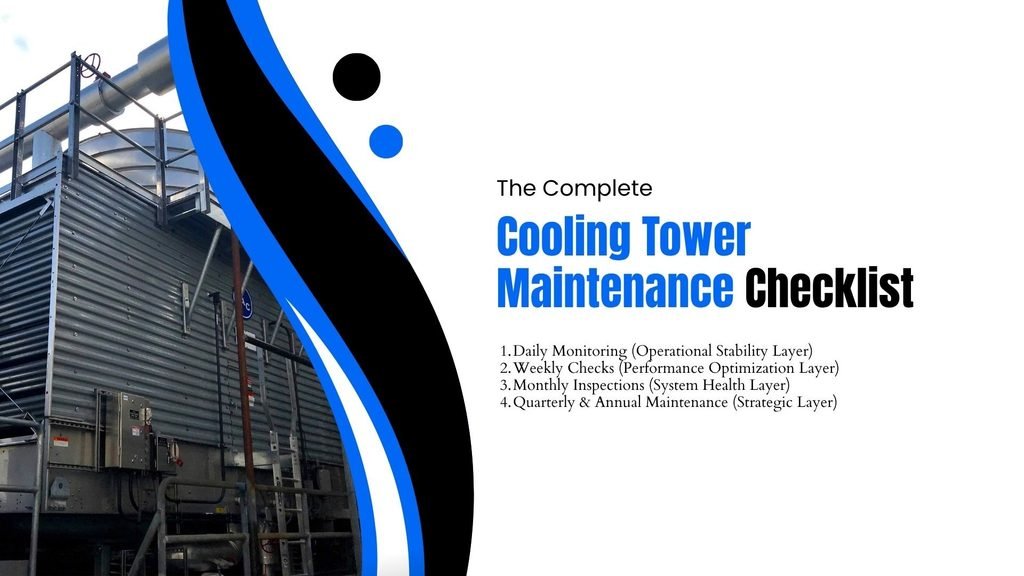
Daily Monitoring (Operational Stability Layer)
Daily checks are quick and mostly visual. They catch problems early, while they are still simple to fix.
- Water temperatures: Record inlet (hot) and outlet (cold) water temperatures. A rising cold water temperature under similar load and weather conditions is often the first sign of a problem.
- Water level and makeup: Confirm that the basin level is stable and that the makeup valve is working normally.
- Visual water condition: Look for cloudiness, foam, algae, or oil on the surface.
- Fans and motors: Listen for unusual noise and watch for visible vibration.
- Leaks: Check the basin, piping, and casing for new leaks.
- Treatment equipment: Confirm that chemical feed pumps are running and chemical tanks are not empty.
Weekly Checks (Performance Optimization Layer)
- Water chemistry: Test conductivity, pH, and inhibitor levels, or review automatic controller readings, against the targets set by your water treatment program.
- Blowdown: Confirm that blowdown is working and keeping conductivity within the target range.
- Basin and strainers: Remove debris and clean the suction strainers. Increase the frequency during the rainy season.
- Distribution system: Check for clogged nozzles or dry patches on the fill, which indicate uneven water distribution. Inspect these cooling tower parts regularly to identify wear or blockage before they affect cooling performance.
- Drivetrain: Check belt tension and wear, and check the gearbox oil level and look for oil leaks.
Monthly Inspections (System Health Layer)
A monthly diagnostic review evaluates the broader health of the mechanical and chemical systems. This is the ideal time to analyze performance trends and adjust chemical treatments. The monthly checklist requires attention to these areas:
- Microbiological monitoring: Use dip slides or ATP testing, as defined by your treatment program, to track bacteria levels.
- Fill condition: Inspect the fill for scale, biological fouling, sagging, or broken sections.
- Drift eliminators: Look for gaps, damaged sections, or misalignment that allow excess drift.
- Motors and pumps: Check bearing condition, running temperature, and amperage draw against the normal baseline.
- Performance trend: Compare the approach temperature (cold water temperature minus the ambient wet-bulb temperature) with previous months. A widening approach under similar conditions points to a loss of performance.
Quarterly & Annual Maintenance (Strategic Layer)
Annual and quarterly interventions require scheduled downtime but deliver the highest return on investment. These deep-dive maintenance tasks extend the life of the asset by years. Based on structured maintenance schedules used in the industry, teams must perform these tasks:
- Cleaning and disinfection: Drain and clean the basin, then clean and disinfect the system following your water management plan.
- Descaling: Remove scale from the fill and distribution system, or replace fill that cannot be cleaned effectively.
- Structural inspection: Inspect the frame, fan deck, casing, fasteners, and basin for corrosion, cracking, or loose connections.
- Mechanical overhaul: Change the gearbox oil, check fan blade pitch and condition, perform vibration analysis, and verify motor alignment.
- Performance review: Compare the tower’s current performance against its design conditions to decide whether it needs repairs, upgrades, or capacity changes.
Managing Legionella Risk
Legionella is the most serious health risk linked to cooling towers. Instead of relying on individual tasks, many facilities manage it through a written water management plan. This approach is described in international references such as ASHRAE Standard 188 and the World Health Organization’s guidance on Legionella.
A practical water management plan usually covers:
- Who is responsible for the tower and for water treatment
- Control limits for disinfectant, biocide, and other key parameters
- Monitoring and testing frequency
- Corrective actions when results fall outside the control limits
- Cleaning and disinfection procedures, including after long shutdowns
- Records of all testing and maintenance
Plants should also confirm any local regulatory or customer requirements that apply to their facility.
Early Warning Signs That Need Attention
Performance signs:
- Cold water temperature rising under similar load and weather
- A widening approach temperature
- Higher chiller energy use or high condenser pressure alarms
Physical signs:
- Visible scale or algae on the fill or in the basin
- New leaks, corrosion, or damaged casing panels
- Increased vibration or noise from fans or gearboxes
- Excessive drift or water carryover around the tower
Investigating these signs early is usually less disruptive and less expensive than waiting for a breakdown.
Preventive vs. Reactive Maintenance
Reactive maintenance means fixing equipment only after it fails. In practice, this leads to unplanned shutdowns, rushed repairs, and higher costs for urgent parts and labor.
Preventive maintenance follows a planned schedule based on the checklist above. Predictive maintenance goes a step further by using data such as vibration readings, temperature trends, and automatic water treatment monitoring to spot deterioration before it causes a failure.
Most plants benefit from combining the two: a preventive schedule as the baseline, with monitoring focused on critical parts such as fans, gearboxes, and water chemistry.
In-House or Outsourced Maintenance?
Few plants handle everything internally. A common arrangement looks like this:
- In-house team: Daily and weekly checks, basic cleaning, and recording data
- Water treatment provider: Chemical program, testing, and treatment recommendations
- Specialist contractor: Shutdown work, structural inspections, fill replacement, mechanical overhauls, and performance assessments
Questions for Managers to Ask Their Team
- Do we have a written maintenance schedule, and is it followed?
- Who owns the water management plan, and when was it last reviewed?
- Are we trending cold water temperature and approach, or only reacting to alarms?
- What would one day of lost cooling cost our production?
- When was the last full structural and mechanical inspection?
Executive Decision Framework | How CEOs Should Manage Cooling Systems
Key Questions to Ask
When it comes to cooling tower maintenance for manufacturing executives, effective leadership requires asking the right questions to ensure facility managers prioritize the right tasks. Use these inquiries to audit your current maintenance strategy. Ask your engineering team the following:
- What is the cost of downtime per hour?
- Are we using preventive maintenance?
- Are efficiency metrics tracked?
Action Plan
Information requires action to generate value for the organization. Implement a strict protocol to ensure your thermal systems receive the necessary attention. Execute these steps immediately:
- Implement a structured maintenance schedule
- Assign accountability
- Invest in monitoring systems
Securing Your Manufacturing Future
Mastering cooling tower maintenance for manufacturing executives requires a shift in perspective from operational chore to strategic advantage. By prioritizing industrial chiller upkeep, leaders protect their facilities from devastating financial losses and dangerous compliance failures.
Implementing a strict preventive cooling schedule guarantees that your production lines remain active, efficient, and profitable for years to come. Do not wait for a catastrophic failure to evaluate your infrastructure; take action today.
Frequently Asked Questions
How often should an industrial cooling tower be maintained?
Routine checks happen daily and weekly, with more detailed inspections monthly and major work quarterly or annually. Exact intervals should follow the manufacturer’s guidance and your water treatment program, and they may need to be more frequent under heavy loads or dusty conditions.
What is the most important cooling tower maintenance task?
No single task covers everything, but consistent water treatment and monitoring prevents many common problems, including scale, corrosion, fouling, and bacterial growth.
How does Thailand’s climate affect cooling tower maintenance?
High temperatures and humidity keep cooling loads high for most of the year, which leaves less time for shutdown work. The rainy season also brings more debris into the basin, so strainer cleaning and biological control need extra attention.
What are signs that a cooling tower needs repair?
Common signs include rising cold water temperature, a widening approach, visible scale or algae, leaks, corrosion, and unusual fan or gearbox vibration.
Should cooling tower maintenance be outsourced?
Many plants handle routine checks in-house and use specialists for water treatment, shutdown maintenance, and structural or mechanical work. The right mix depends on your team’s skills and the tower’s size and complexity.
Also Read
- 141-forest-pickup-lines-that-are-wildly-flirty-cute-and-smoothly-romantic-2026/
- /how-roofing-companies-coordinate-large-projects-without-delays/
- primelunoltd-com-review-the-security-of-your-personal-and-financial-information/


1 thought on “Industrial Cooling Tower Maintenance Checklist for Manufacturing CEOs”